GENESIS: Reboot Study
Chapter 2 - Fini
By Dr. Robert Fieldhouse, Disciples Path Ministry – St. Augustine, Fla.
I pray there is a good understanding of everything covered so far in the Book of Genesis. There is much symbolism, which is reasonably necessary to grasp. Remember that this is a "reboot" of what you have been taught or believed you knew. Is the "reboot" the final word and absolute truth? Hardly, but this is designed to be a springboard for deeper study on your part. Except for direct quotes from our Bible, all I offer is, prayerfully, a viewpoint on Scripture that perhaps you haven't thought of. Let's finish our look at the end of Genesis 2. Ready? Let's go!
Genesis 2:10 describes the flow of a river in the Garden of Eden, which has significant symbolic and practical implications. The verse reads:
"Now a river went out of Eden to water the garden, and from there it parted and became four riverheads" (Genesis 2:10, NKJV). Verse 10 seems like such a simple sentence at first sight. However, let's unpack the Verse and see what we can come up with. From this Verse, we can conclude that Eden had a central location. As of this writing, Eden's exact location remains a mystery. Still, we can reflect on, at least for me, several interesting and inspirational points. For instance, the river begins in Eden, which signifies paradise and Divine Blessing. This combination of paradise and Divine Blessing could suggest that the Garden is a unique, Divinely provided place from which all life and nourishment flow from God's Creation and His presence. The fact that the river divides into four branches could indicate that the Blessings of Eden were intended as a starting point for God's Blessings to all Creation, and that it is intended to spread to all parts of the earth.
Genesis 2:11 provides the first detailed geographical description of the region around the Garden of Eden, explicitly mentioning one of the four rivers that flow from the garden. We read, "The name of the first is Pishon; it is the one which skirts the whole land of Havilah, where there is gold." (Gen. 2:11, NKJV) Pishon is the first river mentioned in the list of the four rivers that flow from Eden. Although the exact location of the river Pishon is uncertain, it is significant in the context of the geography of Eden. In the Bible, the names of rivers and places often carry symbolic meaning. Although we don't have a clear understanding of what "Pishon" means linguistically, some scholars suggest that the name might be related to a root word meaning "to overflow" or "to spread," possibly referring to a river that spreads out over a wide area.
The exact location of Havilah is uncertain, but it is often thought to refer to an area in or near Arabia or perhaps parts of the Arabian Peninsula, with some suggestions including areas near present-day Yemen or the northeastern part of Africa. The verb skirt implies that the river either borders or runs along the edges of the land of Havilah, meaning the river's flow was closely associated with this region. It suggests a connection between the river's path and the geographical boundaries of the land.
The mention of gold, especially here in the Book of Genesis, intrigues me because gold is mentioned and used throughout the Bible. Gold was later associated with the making of the tabernacle and temple. The gold in Havilah, therefore, could point to the untainted, pre-Fall state of the earth where material wealth and Divine blessing were in perfect harmony.
Genesis 2:12 (read) emphasizes the richness of the land of Havilah, where gold, bdellium, and onyx are abundant, highlighting the goodness and abundance of God's Creation, where the original goodness of Creation was spiritually and materially part of His original design. The location of Havilah is uncertain, and various theories have been proposed. Some scholars suggest it refers to areas in the Arabian Peninsula. In contrast, others point to African regions or the northeastern parts of Mesopotamia. I don't believe our focus in the text is meant to be on the geographic location but on the abundance and richness of the land itself. Why would gold, bdellium, and onyx be specifically mentioned at this point? Here is something to consider: gold in the context of the ancient world was highly prized for its beauty and usefulness, and the description that the gold was good could emphasize the land's prosperity. Bdellium is a resin or gum derived from a tree in the Burseraceae family (related to the frankincense and myrrh trees). It was known in the ancient world for its pleasant fragrance and was used in incense and perfumes. Bdellium was considered a valuable commodity in the ancient Near East, much like frankincense or myrrh. Onyx is a gemstone, often black or banded, and was highly valued in the ancient world for its beauty and use in jewelry and decoration. It was used for making engraved seals and other ornamental objects, including in the high priest's garments, as we will discover in future narratives, showing its importance in Israel's religious and cultural practices.
Genesis 2:13 (read) introduces the second river, Gihon. This Verse offers a geographical description of the second river and its relationship to the land of Cush. Cush is often identified with the region south of Egypt, generally thought to parallel the area of modern-day Sudan or possibly parts of Ethiopia. Some scholars suggest that the Gihon might refer to the Nile River, as the Nile flows through the region traditionally associated with Cush. In the ancient world, Cush was recognized as a land south of Egypt known for its wealth and power. Cush is mentioned several times in the Bible, often concerning Egypt. The name Gihon is not fully understood. It might be related to the Hebrew root gāh or gihon, which could mean "to burst forth" or "to gush." The mention of Gihon flowing around the land of Cush could symbolize the idea that God's Creation is not limited to one specific place but is meant to expand outward. Cush represents a region outside the immediate vicinity of Eden, suggesting that the blessing and influence of God's Creation were not confined to Eden alone. God's design for humanity was global, spreading even to regions that were beyond the borders of the Garden of Eden.
Genesis 2:14 (read) introduces the Hiddekel (Tigris) and Euphrates rivers, the third and fourth rivers flowing from the Garden of Eden. These rivers are historically and geographically significant. They help us identify the ancient Mesopotamian region, which will become the birthplace of many of the world's earliest civilizations. The Hiddekel is the third river mentioned in the Genesis account of Eden. In the Hebrew text, the name is חִדֶּכֶל (Hiddekel), which some translations render as "Tigris" in modern English. This river is significant because it is one of the two rivers in the Mesopotamian region that are still identifiable today. The Hiddekel flows through modern-day Turkey, Syria, and Iraq. It is one of the major rivers of the Mesopotamian region, along with the Euphrates. The Tigris was a crucial river for the civilizations of ancient Mesopotamia, such as the Sumerians, Akkadians, Babylonians, and Assyrians, all of which thrived along its banks. The Tigris River is known for its swift current, which may be the reason for its name, which could derive from the Old Persian word "Tigra, " meaning" fast, arrowlike, rapid," or "swift."
The Euphrates River, mentioned in Verse 14, is the fourth river flowing out of Eden. It is one of the most significant rivers in ancient history. It is one of the longest rivers in the world, flowing through modern-day Turkey, Syria, and Iraq, and is considered the lifeblood of ancient Mesopotamian civilizations. The two rivers, along with the now vanished river Pishon (perhaps linked to an ancient river system) and Gihon, are integral to the Fertile Crescent, a region often called the "cradle of civilization." This area, bordered by the Tigris and Euphrates rivers, is where the first known cities and complex societies developed, such as Sumer, Babylon, and Assyria.
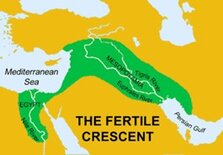 The Tigris and Euphrates rivers, which flow through the heart of the ancient Fertile Crescent, place the Garden of Eden in a historically significant region for the development of civilization. The rivers provided the means for human societies to grow, settle, and thrive.
Genesis 2:15 (read) emphasizes the responsibility God gave to Adam as the first human, putting him, on purpose, in the Garden of Eden to tend (work, cultivate) and keep (guard, preserve) the Garden. This Verse outlines the concept of stewardship, highlighting that humanity's role in Creation is to actively care for and protect the world God created. In this context, work is part of God's design for humanity, not a punishment but a divine calling intended to be fulfilling and meaningful. God's original and intended design for humanity was to live in a paradise and actively participate in its health and blossoming. We are supposed to be caretakers of the earth and its resources and live in harmony with Creation. I fear we have lost our intended way – I digress.
In Genesis 2:16-17 (read), God's generous provision for Adam is highlighted, giving him the freedom to enjoy all the fruits of the Garden. However, it also sets the stage in Genesis 2:17, where the restriction on eating from the Tree of the Knowledge of Good and Evil is introduced. Our last session taught us that the Tree of the Knowledge of Good and Evil introduced the concept of moral choice and obedience to God's will. Take care to bear in mind when God says to Adam that he shall surely die; God is speaking of a Divine Spiritual death, which is a separation from the close, intimate relationship with God and not a physical one.
Genesis 2:18 (read) is the basis for understanding human relationships, especially marriage. While Genesis 2:18 does not explicitly mention marriage, it lays the groundwork for the institution. The Creation of woman emphasizes that marriage is a union of equals. Both are made in God's image and equally responsible for fulfilling God's Creation purposes. This Verse reveals both the nature of human relationships and God's intention for companionship. This Verse teaches us that human beings are naturally relational and that companionship is vital to God's good Creation. Adam's aloneness in the perfect garden is seen as "not good," and God's solution is to Create a companion, Eve, who is complementary to Adam. We see here that men and women are equal in dignity but distinct in role, with the intention that together, they would fulfill God's purpose for Creation. This Verse comes after the Creation of Adam in the Garden of Eden and sets the stage for the Creation of Eve.
The King James version of Genesis 2:18 states, "And the Lord God said, it is not good that the man should be alone; I will make him an help meet for him." Yes, the wording is odd. The New King James version of Genesis 2:18 states, "And the Lord God said it is not good that man should be alone; I will make him a helper comparable to him." Whatever you choose to read, the meaning will remain the same. Despite the perfection of Creation, Adam's solitude is seen as incomplete. I will make him an help meet for him. We read the King James version's confusing words or phrasing help meet. The phrase "help meet" is often misunderstood because of its archaic phrasing. The word "help" here does not imply someone subordinate or inferior, but rather someone who is a helper or partner. The word in Hebrew, Ezer, refers to someone who provides support, assistance, or aid. I digress. In a Christian understanding, marriage is not about hierarchy, conquest, or suppression but a mutual partnership where both individuals bring unique strengths and contributions to the relationship.
Genesis 2:19 states, "Out of the ground the Lord formed every beast of the field and every bird of the air, and brought them to Adam to see what he would call them. And whatever Adam called each living creature, that was its name." (NKJV) This seemingly simple Verse reveals quite a lot to us. We are reminded of our role in the Creation narrative again. It highlights humanity's unique position in the world, being made in the image of God and given authority over Creation. Through the act of naming the animals, Adam participates in God's Creative work, exercising his intellect, responsibility, and authority. Here, in this Verse, the focus is on the formation of the creatures from the ground. It is important to note that animals, like Adam, are formed by God but with a different purpose and nature. While Adam is made in God's image, animals are not. Further, God breathed His breath into Adam, but did not do so with the animals. Nevertheless, they are still part of His Creation and are given life by God Himself.
Genesis 2:20-22 (read) is a crucial passage in the Creation narrative that details the formation of Eve, the first woman, and introduces the concept of the complementary relationship between man and woman. None of the creatures God had made were a fit equal or equivalent to Adam in terms of relationship, companionship, or partnership. While the animals were part of God's Creation, Adam's aloneness pointed to a more profound need: human companionship. This act of bringing Eve to Adam (v. 22) shows God's intention that they be united in a unique way. It is God who introduces the woman to the man, marking the moment of their relationship. The idea of God "bringing" Eve to Adam highlights that the relationship between the man and the woman is Divinely initiated. This moment is not merely about the Creation of a woman but the introduction of a new, complementary relationship. God ordains and Blesses this union as part of His Creation plan. Still with me? We're almost at the conclusion of the Chapter.
Genesis 2:23 (read) proclaims that Adam responds to the Creation of Eve. This moment is significant for its Spiritual and relational associations and for establishing the first human union. Adam's speech is the first recorded words of any human being in the Bible, and they are words of recognition and connection. His immediate reaction to seeing Eve is profound. He recognizes her as something intimately connected to himself. When Adam states Bone of my bones and flesh of my flesh, these are expressions of closeness, unity, and shared identity to me. Adam declares that Eve is not just another creature but a Creation that is part of him. In God's Creation, no person is meant to live in isolation. Adam's recognition of Eve shows that humans are Created for relationships, first and foremost with God and each other.
Genesis 2:24 states, "Therefore man shall leave his father and mother and be joined to his wife, and they shall become one flesh." (NKJV) Genesis 2:24 is a foundational Verse that defines marriage as a Divinely instituted, covenantal relationship. It establishes marriage as a union in which a man and a woman leave their family origins and cling to one another, becoming one flesh. This unity reflects the physical connection between a husband and wife and the emotional, spiritual, and relational oneness that marriage is meant to create. The Verse points to the deep intimacy and commitment that should characterize the marital bond and serve as the basis for the biblical understanding of marriage as a sacred covenant. Finally, as we will discover in future narratives, this passage points forward to the relationship between Christ Jesus and His Church, showing that human marriage reflects Divine love and the unity between Christ Jesus and His people.
We are at the last Verse of Genesis 2. As we will discover later, this one sentence conveys abundant meaning. Genesis 2:25 reads, "And they were both naked, the man and his wife, and were not ashamed." (NKJV) The term "naked" (Hebrew: 'arom) in this context does not just refer to physical nudity but signifies an open, unshielded, and vulnerable state. Adam and Eve were completely free from barriers or coverings in the Garden of Eden. Their nakedness symbolizes purity, transparency, and the absence of shame or guilt. Keep this idea of their nakedness handy, as we will take some time to unpack it later.
Explain why knowing where the four rivers are located is essential in your journal. Why is the Fertile Crescent important?
Sources: KJV, NKJV, ESV, The Bible Commentary Vol.1 The Old Testament (Holman Reference), various Internet-based searches, personal reflections
Disciples Path Ministry – St. Augustine, Florida – U.S.A.